
On-site occupational health: do you need a mobile unit - or just a room?

When planning occupational health assessments, one of the most common assumptions is:
“We’ll just use a room on-site.”
And in many cases - that’s absolutely the right decision.
A mobile unit isn’t always needed. In fact, if you’ve got a suitable space available, it’s often the simplest and most comfortable option for everyone involved.
The key question isn’t “should we use a mobile unit?”
It’s “do we have the right setup to deliver assessments properly?”
What actually makes a room “suitable”?
Most occupational health assessments don’t need anything complicated - but they do need the basics done well.
A suitable room should be:
Private (so employees feel comfortable discussing health matters)
Quiet enough, particularly for things like hearing tests
Clean and safe
Large enough for a desk, chair and equipment
Available for the duration of the assessments
If you have a space like this - a quiet office, meeting room with privacy film, or similar - then using your own site is often the easiest solution.
Where things can go wrong
In reality, this is where most problems happen. It’s quite common to arrive on-site and find that the “room” is:
A shared or high-traffic space
Too noisy for accurate testing
Not private enough
Or not really a room at all - for example, a shed, welfare unit or temporary space
In those situations, it becomes very difficult to carry out assessments properly.
Health surveillance needs to be reliable - both for the employee and for your compliance - so the environment does matter.
When a mobile unit becomes the better option
A mobile occupational health unit is useful when those basic requirements can’t be met on-site.
This includes situations where:
There is no suitable indoor space available
The environment is too noisy or exposed for certain tests
You need a controlled clinical setup (for example, hearing tests or drug testing)
Teams are working in temporary or outdoor locations
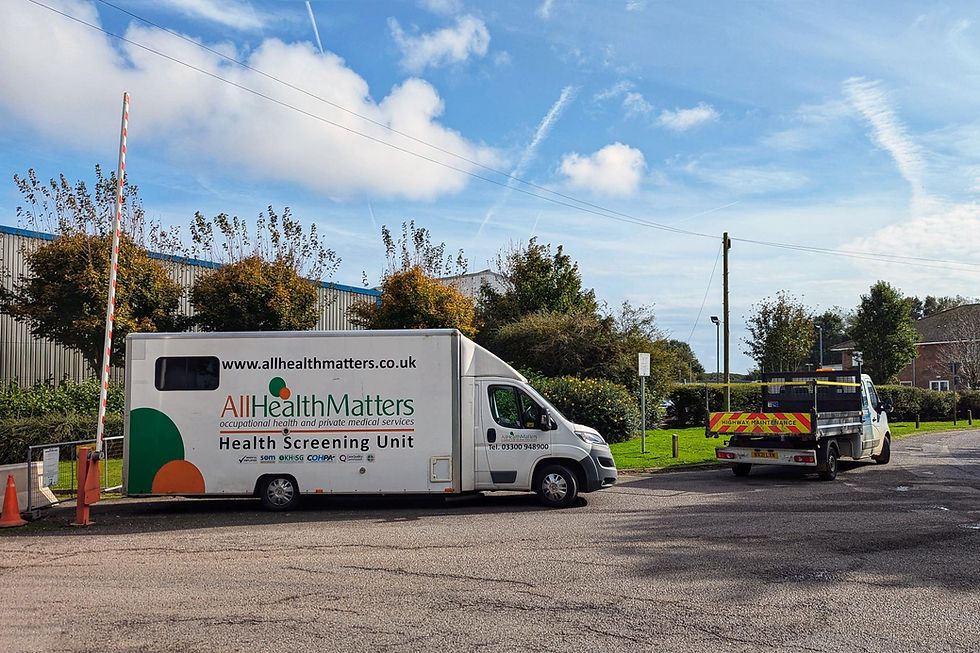
A common example is roadside or utilities work.
You might have teams working from vans or small welfare units, with no private indoor space available. In those cases, bringing a mobile unit to site means assessments can still happen safely, without sending people away from the job.
A realistic way to think about it
Rather than choosing upfront between “room” or “mobile unit”, it often helps to think in this order:
1. Can we provide a suitable room?
If yes → that’s usually the simplest option
2. If not, what’s missing?
Privacy, noise control, space, cleanliness?
3. Would a mobile unit solve those issues?
If yes → it’s a practical alternative
There’s no one-size-fits-all answer - it’s about what works in your environment.
A note on comfort and practicality
Mobile units are designed to be practical and self-contained, and they can work really well in the right situations.
However, like any outdoor-based setup, they are more dependent on conditions than a fixed indoor space.
Extremely hot or cold weather can make them less comfortable over long periods
Heating and cooling systems help, but a well-controlled indoor room is usually preferable where available
So where you do have a good indoor space, it often remains the best option.
In practice, most businesses use both
In reality, this isn’t an either/or decision.
Many organisations across Kent, London and Essex use a combination depending on the situation:
On-site rooms where facilities allow
Mobile units for sites without suitable space
Clinic appointments for individual or follow-up assessments
The aim is simply to make occupational health work in a way that is practical, consistent and reliable.
Final thought
Occupational health doesn’t need to be complicated - but it does need the right setup.
If you have a suitable room, use it. If you don’t, there are flexible ways to work around that.
The most important thing is making sure assessments can be carried out properly, safely, and with minimal disruption to your team.
If you’re unsure whether your site is suitable, we're happy to talk it through with you before anything is booked in.
Frequently asked questions
Do you need access to power on-site?
In most cases, no.
Our mobile unit can usually operate for a full day visit without being plugged in.
Access to power may be required:
For multi-day visits in the same location
During colder months, when heating is in use
Where higher-power equipment is needed
If power access is required, we’ll confirm this with you in advance.
What counts as a suitable room on-site?
A suitable room should be:
Private
Quiet enough for accurate testing (particularly hearing tests)
Clean and safe
Large enough for a desk, chair and equipment
A standard office or meeting room is usually ideal.
If you’re unsure, we’re happy to review photos or a description of the space before the visit.
What if we don’t have a suitable room?
If a suitable space isn’t available, we can use our Mobile Occupational Health Unit instead.
This provides a fully self-contained clinical environment on your site, ensuring assessments can still be carried out safely and reliably.
Will the mobile unit be comfortable in all weather?
The unit is equipped with heating and cooling to help manage temperature.
However, as with any mobile or outdoor-based setup:
Very hot or very cold weather can make conditions less comfortable over longer periods
Where a suitable indoor space is available, this is often the preferred option.
When is a mobile unit usually the best option?
A mobile unit is particularly useful where:
There is no suitable indoor space available
The environment is too noisy or exposed
Teams are working in temporary or outdoor locations (e.g. roadside or remote sites)
A controlled testing environment is required
Can you help us decide what’s best?
Yes - we’re happy to talk through your setup before anything is booked in.
In most cases, a quick conversation (or a few photos of your space) is enough to confirm whether a room will work, or whether a mobile unit would be more suitable.


I really appreciated the way the author organised the information. The content is well balanced between theory and practical applications. I printed some parts to have them available while working. It is a text that provides a clear and well-organised view of the topic.